


Saturday, 13 December 2025
20:33
I’m in my living room on the lazy chair with my laptop on my lap. The TV is on. Nobody’s watching it. My older brother is sitting on the sofa next to me, telling my niece—his daughter—that she needs to finish her papaya, then carries on playing a video game on his iPad. My Mom is in the dining room having dinner, and my Dad is upstairs, probably reading his newspaper. It seems that my niece has disposed of the papaya on the floor, to my sister-in-law’s disapproval, and this 2.5-year-old proceeds to hop on her pink balloon as if it were a ride-on horse. She abandons that game pretty quickly and is now occupied with trying to figure out how the digital thermometer works, producing beep-beep sound as she goes. In the coming weeks, the house will be noisier as family members return. I should probably get all my work done before then.
Life update. I’ve been home for about three months now. (By home, I mean Bali, in case you’re a new reader.) I’d say most things I need to set up are already in progress. I have my own workspace. It’s on the second floor with windows facing the big tree in front of my building. The first evening I spent working there, I noticed two squirrels actively going up and down the tree, hopping freely from one branch to the next. After a while, I realised there are probably more than two. Sometimes they would use the power line as a kind of highway to get from one part of the neighbourhood to the next.
Squirrels aside, being back home after being away for some time has made me quite reflective of my life’s choices—past and future. I am confronted again and again with the reality of the work that I do, and I find myself being utterly stubborn that I’ll find ways to make things work at some point, be it in the near or distant future. With enough gravelling and trials and errors and strategising and brainstorming and writing and embarrassing myself on LinkedIn, I think I can make something worthwhile. More on that later.
I received a call earlier this month while I was out for brunch from someone I don’t know, who got my number from someone I also don’t know, who got my contact from someone I know a little. I was offered a chance to interview for a role I hadn’t really considered until that point. It’s within my field of interest, but it’s an entirely different profession. I would have to relocate to a different city if I were to take it. This past week, I’ve been sitting on it, and the broader themes that must be considered with it. It’s forcing me to answer questions I should probably have pondered thoroughly by now: how badly do I want to do the things I said I wanted to do (i.e. build my own platform)? Why do I want to do it? Why does it matter? Why does it deserve my full attention and the limits of my efforts?
There’s a lot to unpack here. Let’s start with the elephant in the room: my profession is changing, and I must change along with it.
I’ve been warned that journalism is a sunset industry since I first entered the scene. In the past couple of years, I’ve seen enough turnovers, resignations, burnouts, layoffs, and outlets closing to know that this is not an industry you’d go for if you’re looking for job security. Or a decent living—but that one I’d say is arguable. (I don’t want to perpetuate the notion of impoverished journalists.)
That is to say that for so long, I haven’t been deterred by the gloomy outlook of this world. Up until recently. The integration of generative artificial intelligence (AI) in my industry—media and journalism—has made the work less and less appealing to me. I’ve wondered to myself: could it be that I’ve changed and I just don’t have it in me anymore? That oomph to go work on exciting stories? That drive to do something meaningful with my time? But from what I know about myself, I don’t think that’s true. If that were true, I wouldn’t even bother writing this down, trying to decide a way forward. I’m more persuaded to believe it is a symptom of an industry changing. And it has changed quite a bit.
For one, AI has become so pervasive in editorial departments. This is not just an individual preference; it’s institutional. There are organisations whose work is to produce editorial pieces, which have externalised a good chunk of their work to AI. There are AI writers, AI editors, and AI illustrators. Sometimes editorial teams would flag the output as AI, sometimes they don’t. While some people, be it the producers or the consumers, don’t seem to mind (as long as it’s good work, who cares if it’s AI?), it seems to me that its adoption to the editorial workflow is mostly done uncritically. It is this lack of thought that has been gnawing at me.
I’ve been sitting on this for long enough to know I’d be better off writing this down. So, this is me, writing this down. What I’m trying to point towards is the scope of impact I have personally witnessed, as well as how it’s affecting me, a practitioner in the media industry.
It would probably help to have some kind of framework to imbue a sense of direction to this accounting. I’ll use what I’ve been working on for the past couple of years as that framing. Let’s start with setting intentions.
I’ve been on a search. I’m trying to find a voice. I think the hallmark of a good writer is that they are distinct. They have a voice. What does that voice sound like? How do you describe it? Is it ever something that you can essentialise? That is, reduce to a single idea? How do you find a voice?
I’ve been pondering these questions for some time now, albeit crystallising them into this framework of “finding a voice” is a recent development. But wordings aside, the spirit of this inquiry has led me to quit a decent paying job; to live off of my savings for a little less than a year (9 months, to be exact); to put my head down and prep for a new chapter (which felt like a big risk because I was aiming to secure a full-ride scholarship the same year I started trying—for context, it’s common for people to try over and over, with stories circulating of how some only gotten the scholarship after trying 7, 8 times); to move halfway across the world to a country I’ve never been to where I know, basically, no one; to go on another chapter of “soul-searching” after that programme ended; and then to start anew again.
I don’t normally frame things in this light—as if it’s some kind of this grand thing. My outward tendency has been to make things smaller than they actually are, so they don’t weigh on me that much, so I don’t make promises I can’t keep. But on this rare occasion—where it’s fitting—I’d like to embrace the weight that surrounds the search. I have been betting a good part of my adult years thus far on this pursuit. I think I’m doing myself a disservice by not acknowledging that.
This voice has been something I’ve been made aware of upon entering the media and journalism industry. It was an awareness that had helped me adapt relatively quickly to media organisations I’ve worked for in the past. My former editor and mentor at The Jakarta Post said I was one of the fastest learners in the newsroom, having witnessed my switch from writing as a City reporter to a Business reporter. Three months in my next company, The Ken, I was made employee of the month. My editor commended me for my learning curve, having seen noticeable improvements in my drafts. I’m not saying this to brag (okay, maybe a little), but mainly it’s to point at the conscious effort to identify and emulate what this specific publication sounds like. They all sound different, regardless of how slight. I gave myself the time to adapt to the tone and texture of their sounds, but always with the understanding that this is their voice, not mine. It’s also the reason why I’ve held back from making a public presence during my time working in my previous companies. I didn’t want their voices to be mine. I’m happy having developed the muscle to operate these different voices, but there is this nagging feeling, intuition, or whatever you want to call it, that the voice I’d like to be known for is distinct from the voices I’ve learned to echo. That is the basis of the search.
What exactly is this voice? Experientially, at least in the past, the voice feels like putting on a mask where, once you have it on, you adopt a certain kind of worldview, sensibility, value system, as well as an imagining of who the readers are, how they behave, and your unique relationship with them. The voice dictates what kind of writer you get to be.
At The Jakarta Post, for instance—in this case, at the business desk where I served—there was an understanding that you’re speaking to time-pressed readers. Most of them are scanning headlines and paragraphs, so you need to get the information out quickly. Business news, especially that of the stock market, which I covered for a bit, is meant to feed a larger machine of decision-making, so it needs to be templated and clean. No unnecessary bits. The voice is lean and effective. At The Ken, it was that of a critical business manager. I needed to think like a capitalist to sound like a capitalist to write for capitalists. The voice I operated with values rationality, clearheadedness, and prestige; it sees numbers as a guiding and defining metric of worth. You could say that the voices I’m describing here could be generalised into their broader category: the voice of a general news outlet for the former and a tech-business outlet for the latter. But the point I am trying to make is: they are all pretty arbitrary! Somebody woke up one day and decided this was how things should be done, and they iterated along the way, and then the voice solidified. When it did, it made it seem like it was the most natural thing—to speak in this particular way—as if it’s the only way to go about doing things. (It is not.)
The concept of “having a voice” takes on a new level of significance now that everyone is using large language models (LLMs) to write. I shouldn’t be exaggerating by saying everyone, but it’s more to the effect that it’s so normalised. Its adoption is currently at a point where it’s widely used, but, at the same time, there’s still a level of disdain to its usage, where you would find people going on a witch hunt trying to identify the sounds of LLMs—the vocabulary, style, and phrases. Oh, if there are too many em dashes! If there are no typos! If they speak too clearly! If they repeat the “it’s not X, but Y” framing! What we’re witnessing is an erosion of trust in good writing. But the thing is, good writing does not equal having a voice. Having recurrent sounds does not make a voice. Sounds can be borrowed, traded, and altered. A voice is something else. There is now more urgency than ever to have a voice.
A few months ago, I was asked to judge a student essay competition. It was a small one. I only needed to read 8 essays (the committee was expecting almost twice the number of submissions). It was my first time doing it, and it became an interesting experience taking on that role at a time when AI is already widely used.
I had run some prompts on the essay topic before receiving the submissions, trying to get a sense of what the topic could explore. I noted them down, keeping them in mind as I prepared a presentation about essay writing, to be delivered as part of a workshop for the participants. I made a note about how it’s important to be in tune with the reason why one writes, especially when it’s easy to outsource that work today. I argued that writing is a process, it’s an exercise—to get you from one point of not knowing to another point of knowing a little better. I wanted there to be a sense of commitment to the process of writing.
When the submissions got in, and I went to give my first read, it struck me how there were so many overlaps in ideas. They’re not bad ideas. In fact, they’re pretty interesting as stand-alone pieces. And if I wasn’t aware of the results that came from my quick prompting session. I didn’t exactly mark the pieces down for using AI. First, you can’t outlaw the use of AI entirely (at that point, I had also been using AI’s assistance for research purposes). Second, my hunch was still in the realm of allegation (it wasn’t like there was a truth-finding committee in place). But I couldn’t give a high score on originality. You can’t win that aspect when others are presenting more or less the same thing.
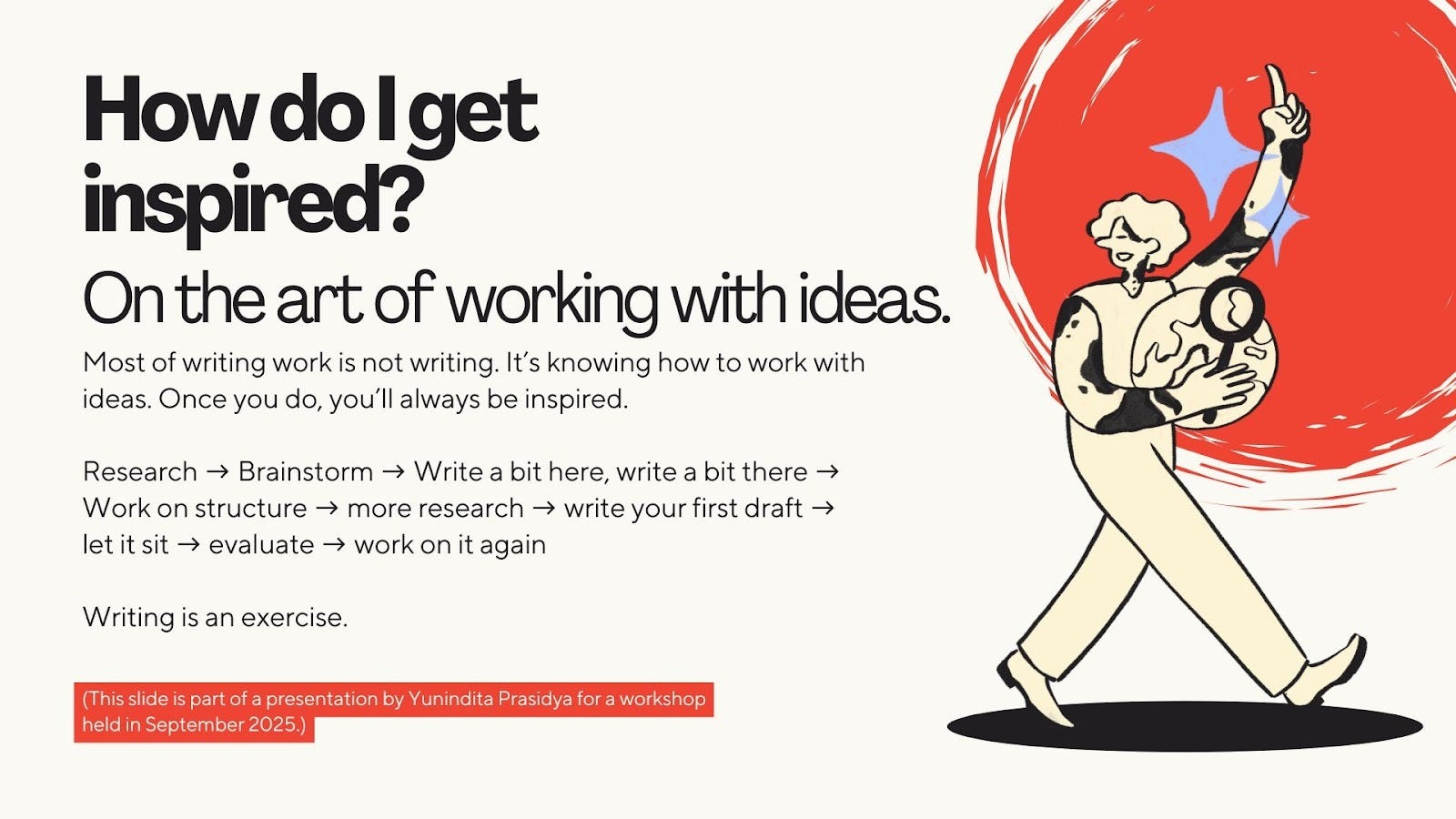
It does put things into perspective. As a writer in an LLM world, it’s not enough to be correct. In a sense, being able to tick all the boxes that need to be ticked. Yes, the ideas fit with the topic of the competition. Yes, some of them were presented adequately. But if the marketplace gets more crowded and is increasingly awashed by mass-produced, undifferentiated goods that are easily replaceable by one another, what is the value of another good that’s similar? It left me with plenty of food for thought about the work I’d like to do going forward. About the kind of writer I’d like to be.
I’ve mostly associated myself with the role of a tech-business journalist. But in the past year, from conversations with several tech and business outlets, it’s not the best market to be a techbiz journalist these days, especially in this part of the world—Southeast Asia—where things have been persistently slow compared to the peak of startup investing in 2021 and early 2022. Readership of tech from the region has gone down significantly. Yes, you could write about AI startups emerging from the region—they still have currency in this market. But if you’re an investor looking to invest in AI startups, you’d probably look more closely at what’s coming out of Silicon Valley, or you’d look further east—maybe Japan or South Korea, if China is not an option. What does a tech journalist who’s based in this region get to write about then?
What I’m saying is tech journalism has changed. What has sustained it thus far is being eroded. The funding rounds that used to drive much of tech reportage do not attract as many eyeballs. One, there have not been as many and as large rounds as there used to be. Two, many journalists who used to cover these rounds had been laid off. Three, people find them less interesting, less relevant. A few funding rounds here and there do not change the gloomy outlook that overcasts the industry. Four, even if there are newsworthy updates, chances are, AI would write these pieces. This is the state of industry I’ve found myself in.
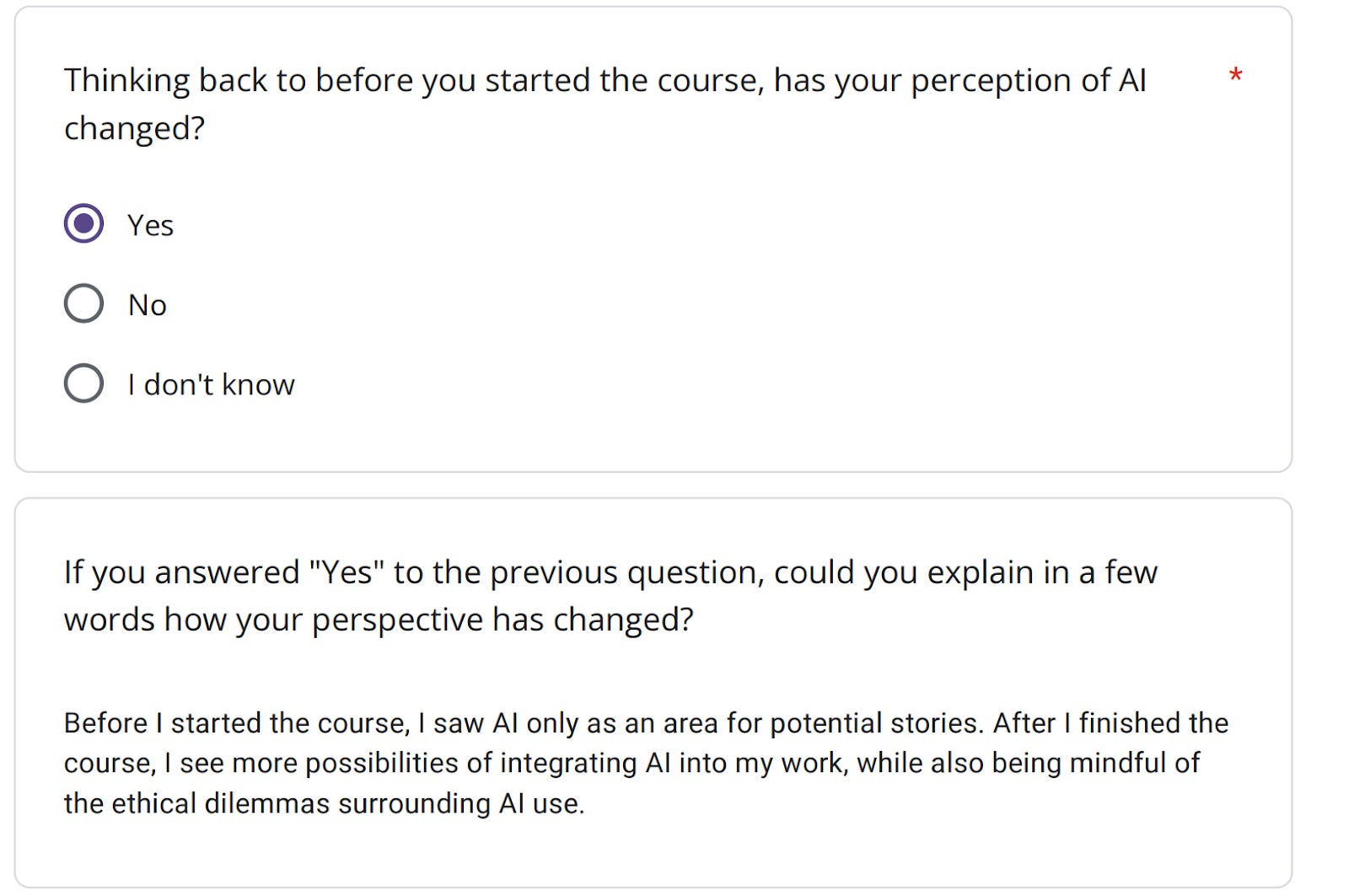
Two years ago, on my first week in London, I attended a report launch event at the Financial Times office on Friday Street. The report was about the adoption of AI in global newsrooms. Earlier that year, I had joined a self-paced course set up by the event organiser—Polis, LSE’s journalism think tank—that covers, among other things, how AI is used in journalism and how to start an AI project. I finished the course’s material feeling rather inspired. In the feedback survey I submitted, to the question of whether my perception of AI changed from before I started the course, I said yes. Many interesting use cases were brought to my attention, especially in the area of audience engagement and system-building—the way newsrooms can utilise AI to build recommendation algorithms for their audience and how AI can be used to investigate AI. That is to say, I was quite open to a world where AI is embedded in newsroom processes, putting into consideration the ethical dilemmas surrounding its usage. But for some reason, we—the media industry—haven’t been particularly good at acknowledging and addressing these dilemmas. Perhaps this exchange shared during the question and answer session at the report launch captures the attitude of many media organisations across the globe:
Journalist: We know that AI models are morally compromised, and we don’t know how morally compromised they are because we can’t exactly see how they’re trained. How do we deal with that?
Panellist: We still use X, we still use Facebook and Instagram and WhatsApp, and we know they’re morally compromised as well. As long as we keep the human in the loop and are transparent with how we’re using the tool, it’s not dissimilar to the use of these other tech products.
(I wrote my thoughts about this in a separate blogpost.)
I find there’s something quite odd about the media industry’s critical outward outlook on the world and its unwillingness to use that same lens towards its own industry. I’d say the result of that is exactly what we are—or I am—seeing today: instead of interesting use cases of AI, there are more sloppy ones. The ones that are there because newsrooms couldn’t be bothered. They couldn’t be bothered to train new journalists. They couldn’t be bothered to commission illustrations to accompany their written pieces. They couldn’t even be bothered to disclose that they have AI writers. How do you expect to have a clear voice in a scene so muddy?
There is a case to be made for a different kind of technology writing. One that is more humane. One that puts the humanity of the readers, the subjects being covered, and the journalist front and centre. I’m building digital field notes to explore what that could look like. I want it to be a home for stories that make you feel more human, as opposed to more detached and disconnected.
I’m starting a new chapter for this project. 2026 will be different. It will be bolder. It will be more grounded.
I’m embracing this project of finding a voice for myself that is in service of this mission to humanise technology. I’m not going to promise that this is going to be a linear process. Perhaps it’s going to be a bit messy, a bit chaotic. Maybe it’s the adult equivalent of my niece picking up the papaya, then dropping it to the floor, experimenting with using the balloon as a ride-on horse, and seeing what this weird-looking object that’s making the beep-beep sound is about.
What I can promise is that every inquiry will come from a place of genuine curiosity, and they will be stories you would like to sit with, and they will be stories that stick around long after you finish reading them. I hope to meet you again this time next year with a recap of what those stories are.
Until then, to a new chapter.
What a well written piece! As someone with a media studies background, how traditional publications and media are adapting with the ever-evolving tech and financing model and balancing them with their core values revolving around factual & quality reporting is always an intriguing tension to observe. I'm looking forward to seeing how digital field notes can evolve into a new form of journalism.
One trend that I've seen increasing is how journalists evolve into a brand themselves, and now institutions seems more fractured and closely related to a figure (eg: Ezra Klein, Cleo Abrams, or HowTown, or just how substack operates). Though these seems to induce a question on what is the future of media institutions looks like. So many questions!