

Bedbound, in pain, doomscrolling life away
Doomscrolling is known as a dopamine booster, but what if it’s a painkiller instead?

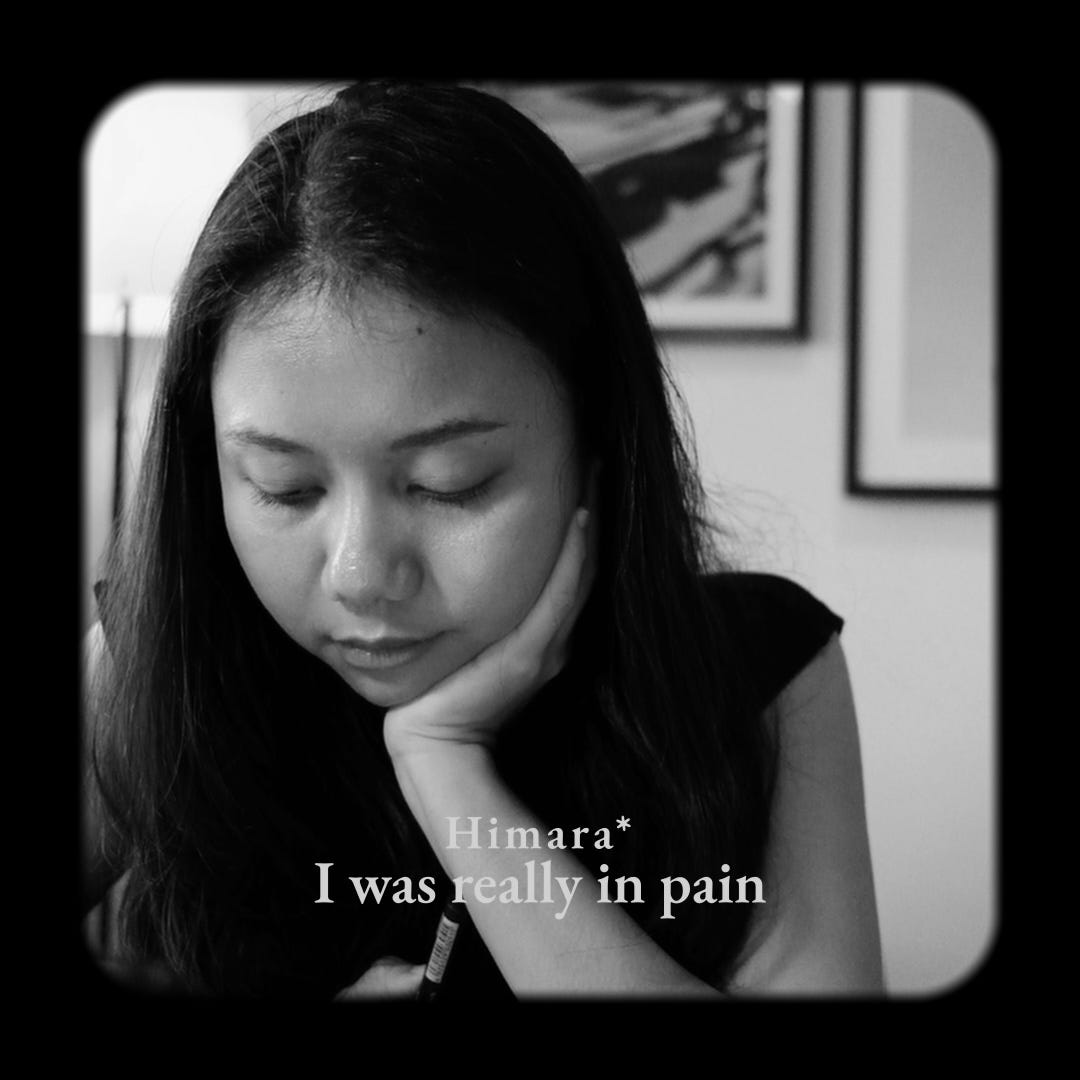
It was late at night on a Tuesday in January 2024 when Bumi Himara* checked herself into a hospital.
It was not the first time she had experienced this type of pain in her body. But it had never gotten as bad as it did that night. Like many young professionals who migrated to the city—Jakarta—she was living by herself. In an unexpected situation such as this one, she found herself having to manage on her own as well. She was a 20-something-year-old at the time.
Then came the bad news: the doctor would not be arriving until morning. So, there she was, assigned to a room, trying to rest on a hospital bed, unable to sleep, unable to do much of anything, trying to wait until morning came.
The only thing she could afford to do was to doomscroll. And that was what she did. From 11 PM until 8 AM, she scrolled, scrolled, and scrolled.

Himara was one of the people who responded to the Instagram story I posted in January. I wrote: How often do you doomscroll?
Himara replied, “Almost every day.” I asked if she would be interested in sharing more via a call. We conversed on a Sunday afternoon in the same month.
After about 20 minutes of discussing media habits, social media usage, and preferences, Himara told me about that night in the hospital.
“How did you feel throughout those nine hours of doomscrolling?” I asked.
“I was just in pain. I can’t think of anything else. I was trying to redirect my attention [away] from the pain,” she said.
This is a different mode of doomscrolling.
On a regular day, Himara would scroll right after she wakes up, before she starts getting ready, and then right before bed, after she takes her evening shower. From time to time, she would find herself scrolling longer than she expected herself to. But on the whole, doomscrolling is a part of her daily routine, not a disruption to it. The way Himara describes it, it is an aid for her to ease into and ease out of her day.
That night, it functioned more as a painkiller.
I wanted to get a sense of what Himara was watching during that nine-hour doomscrolling session. What could possibly be a good distraction when one is dealing with an emergency alone in a big city?
Himara shared during our call that she enjoyed watching medical content. After the call, I asked her if I could have the names of the content creators she was watching. She told me on the night of her emergency, she was watching a lot of short-form videos from @steveioe, or Steven Ho, on Instagram.
Ho is a retired ER technician who posts comedy content inspired by his real-world experiences. At the time of writing, he has 1.3 million followers on Instagram, 11.5 million on TikTok, and 3.25 million subscribers on YouTube.
I scrolled down Ho’s Instagram account all the way to videos he posted before Himara’s night at the hospital. There were skits of Ho dealing with a patient who: faked their urine sample; refused height measurement and stated they were 7’11”; refused to see a doctor who shared the same first name as her cheating husband. There were also clips from his stand-up comedy show. In one of the clips, posted in August 2023, he started the set with the following prompt: “We’re going to play a game. Is it an emergency?” With that alone, the audience erupted in laughter.
I could understand how this helped Himara take her mind off things. It has this effect of normalising medical emergencies in such a way that makes them less scary.
I also couldn’t help but find it quite amusing how one dealt with one’s own emergency by laughing at skits of other people’s emergencies.
Life loops itself in a funny way.
Himara isn’t the only person who has relied on doomscrolling as a kind of painkiller. Kin* has also found herself doing something similar.
“What was the longest doomscrolling session you’ve ever had?” I asked Kin over the phone. It was a Friday afternoon in January. We hadn’t spoken for years until that call. She responded to my Instagram story, and we got talking.
“Honestly, I never count the hours. But I guess it was during the time I was unemployed,” Kin replied.
Kin went through three layoffs in the past five years—one was a contract work that did not get extended, but it felt like a layoff regardless. There was a period in between work where she decided to pause her job search and counted it as a break from her professional life.
It had been some rocky few years of being exposed to job vulnerabilities that were outside her control. A company that went bust. A department that got dismantled. A changing government regulation—effectively shutting down her line of work. Promising work in emerging fields soon enough became a source of precarity.
“I would wake up, open my phone, and doomscroll. I would have my meal, go back to bed, doomscroll again. In the evening, I would eat, go back to bed, doomscroll again,” Kin said.
“During that period, I wasn’t going anywhere. And I was a bit depressed, so I wasn’t really taking care of myself, aside from having meals. I wasn’t eating that much, either. It [doomscrolling] took up almost the entire day. And it wasn’t just a day or two. Maybe three days a week when I wasn’t going anywhere, when I was staying in. So I was doomscrolling at all times, outside of bedtime and mealtime.”
Other alternatives felt taxing—mentally, physically, financially. Even meeting up with friends came with expenses, and her spending capacity was limited at the time. Doomscrolling, on the other hand, is free. “All you need is your phone,” Kin reckoned.
“When did you stop with that pace?” I asked Kin.
“I think when I started working,” Kin said.
But that period in her life left a mark. She worries that whenever she has the day to herself during the weekends, she would regress and spend her day doomscrolling instead. She has ideas of things she would rather do in her free time at home—reading a novel or playing a game—but the thought of her slipping up and doomscrolling prevails. It has morphed into a kind of fear. She’s afraid that she would end up wasting her time.
This tendency of hers to doomscroll was something she had discussed in passing with her therapist—she went to therapy regularly during the period she was unemployed. The therapist suggested slow living, a lifestyle built on the principles of mindfulness and intentionality, which would require her to address her constant need to pick up her phone. From her sessions with her therapist, she got the impression that she might be dealing with phone addiction. She has yet to explore this further.
“Do you think you’re addicted to doomscrolling?” I asked.
“I guess, I guess. I mean, like when I was unemployed, it was very apparent it was an addiction. I was spending the whole day in bed with my phone. Isn’t that not normal? Even if you’re unemployed, I think that’s not normal,” Kin said.
Having a job helps. A job means routines, money, and the discretionary spending to go out and do activities with her friends.
But that she can’t sit still and let her mind wander off on its own bothers her.
“When I drive by myself, I would still doomscroll. As in, when I’m stuck in traffic, and it’s not moving. I would open TikTok, I would open Twitter, and I would scroll. It already crossed my mind that I should probably stop. But I can’t. I can’t just let things be still. And I already have the music on when I drive. That’s already something that fills up [the space]. But still, I need something I can consume.”
Just my luck. The week I was supposed to be reporting for this series about doomscrolling, I fell ill. A few calls were rescheduled. I was bedbound for two whole days. My head was dizzy, I felt nauseous. I couldn’t remember the last time I felt so weak. With family members away or otherwise occupied during the day with work, the few hours I was up and awake, all I could do was scroll through my phone.
The irony didn’t escape me. The coincidence of it all felt rather comical. The universe has a dark sense of humour, I thought to myself. If I weren’t the butt of the joke, I would probably appreciate the narrative alignment. “Good one!” I’d say.
But self-pity aside, I reckon these initial conversations are pointing to something we’ve perhaps taken for granted. That only so much about the way we use technology is about the technology per se. A lot more has to do with the lives we live around it.
For that reason, I believe the more interesting question, and the one we have yet to ask ourselves enough of, is not how technology is shaping the world, but what our technology usage says about the world we live in.
What is the state of the world we are trying to navigate? How could the way we use digital technologies become a window into our lives? Our plights and grievances? Our hopes and joy?
I’m beginning to wonder what kind of modern life we are living to make doomscrolling as irresistible as it is today.
I’ll try to explore that in my next edition.
See you next week.
*Note: The name is pseudonymised.
This edition is part of a series called “An Algorithmic Becoming”. I’m exploring how our lives have become deeply entangled with algorithms and algorithmic technologies. Follow along to see where it leads.
Read the previous edition here:
