

Why do I doomscroll?
I’ve been asking people about their doomscrolling habits, trying to get a sense of why we doomscroll

This is the first edition of a series called “An Algorithmic Becoming”. I’m exploring how our lives have become deeply entangled with algorithms and algorithmic technologies. Follow along to see where it leads.
On 14 January, I reached out to my network—posted a story on Instagram—to ask people about their doomscrolling habits. “How often do you doomscroll?” I asked. Thirteen people responded.
“Way too often it’s unhealthy.”
“Sadly, it’s becoming the first and last thing I do in a day.”
“To the point where I mentally do not want to do it, but I physically can’t stop.”
Most of the replies carried the same undercurrent of self-judgment. I can relate to it.

I’m a doomscroller myself, if there is ever such a description. I think there isn’t because people think of doomscrolling as something they do, not something they are. If anything, it’s something people claim they try not to do. Hardly something one would like to be known for.
But doomscrolling is a fact of modern life. I’d argue it’s a fact we don’t talk about enough, considering how common it is and how few frameworks we have at our disposal to understand it.
It could very well be that we just don’t know how to talk about it. What is there to say about doomscrolling other than it being something one confessed to when asked and signalled a desire for change upon realising how much it has crept up on one’s life? At least that was the impression I got from having conversed with five out of the thirteen people who had responded to my outreach on Instagram.
I was—and still am—not that interested in making a case on why people shouldn’t doomscroll; why they should stop and outgrow it. It’s not a project I’m currently pursuing (although I can see how it could be a valuable enterprise). I am more interested in understanding why we do it. Why do we doomscroll?
It’s a deceptively simple question to ask because it seems like we know the answer already. We scroll because we are habituated to it, because our social media is designed as an addictive interface, because attention is money, and because Big Tech capitalises on our unassuming, impressionable nature.
But I don’t want the top-down explanation. I wanted a more grounded answer. Something that resonates with me.
Maybe it is to help me feel like I can actually do something about it. Maybe it helps make the issue seem less obscure. I’m not sure. I’m still figuring it out. Intention is a thing that shapeshifts and escapes when pinned down.
The main point is: I wanted a different take.
What I didn’t expect from having the conversations that I had—even when they are in total still a small number (five)—was how personal they became. It turns out, when you ask people about their doomscrolling habits, you are essentially knocking on a door to their innermost worlds. It’s like seeing the interiors of someone’s house for the first time, and you are introduced to the owner’s quirks and peculiarities—ones you wouldn’t have known without the visit.
I’ve learned that doomscrolling has occupied a special corner in people’s lives—whether they like it or not, regardless of how they are inclined to moralise it. It fills up people’s most private time. It is a companion one leans on during one’s alone time, whether that aloneness is by choice or by circumstance. There’s an intimacy there that we have yet to fully appreciate, or are unwilling to, perhaps because it feels somewhat odd to declare doomscrolling as anything other than despicable.
Immediately, the issue seems to be that it’s difficult to get a straight answer as to why one doomscrolls. It’s possible it’s because there isn’t one. From conversations I’ve had, there is the impression that it’s an answer that is still in formation. The response of “Ah, I haven’t really thought about it” is quite common. It points to the different levels of reflection required in answering questions about behavioural patterns vs questions about intentions. As in, it’s markedly easier to share that one doomscrolls every morning before work and every night before bedtime, but harder to explain why one does it. We would rationalise and come up with reasonable guesses, of course. But certainty is never a given. Intentions are elusive creatures, as I, too, have recognised myself.
I’ve found this lack of directness quite interesting. It shapes the way I approach my inquiry. Instead of asking the big, vague, intimidating question of, “Why do you doomscroll?” I broke the question down into a few lines of inquiries I thought were easier to answer (they are still difficult questions, but at least they have a more concrete shape). Among the questions I asked were: “How does doomscrolling make you feel?” and “Are you looking for anything in particular when you doomscroll?”
My conversation with Gaia helped me with that direction.
Gaia* is a longtime friend. She was among the thirteen people who responded to my outreach on Instagram. In the DM, she told me she doomscrolls a lot. She was the first person I spoke to for this series.
We caught up on a Thursday evening in January while she was in town. I suggested a pastry shop I’ve come to frequent as a meetup spot. The place used to be very busy some years ago. But these days, when I come by, it’s usually conducive enough for work sessions and coffee chats.
Gaia has worked as a psychologist and is currently pursuing further study for the profession. She told me this chat we were having felt like a therapy session.
“Who’s the client? Who’s the therapist?” I asked.
“You’re the therapist,” she responded.
“But you’re the one with the psychology degree.”
“Well, I’m on a holiday.”
We both laughed.
Gaia told me she would usually start her session by asking her client: What do you want to talk about today?
I took the liberty of putting on the therapist hat and asked my dear friend that very question.
“So, what do you want to talk about today?” I asked with a smirk.
“What do I want to talk about today? I want to talk about… I don’t know,” she replied with a chuckle. “See, this happens in therapy.”
It’s common for people to reply with an “I don’t know” when asked why they’re in that therapy chair. But they feel the need to be there, she explained.
She would encourage her client to say anything that was on their mind, and, along the way, she would help them recognise their thoughts, feelings, and actions—the former two often get mixed up. Usually, when she asked her clients about their feelings, she would get a response about what her client was thinking instead.
“We are never taught to recognise it [our feeling]. We always treat emotion as a secondary element and cognition as the primary.”
The topic of doomscrolling had emerged in therapy sessions my friend had hosted. The people she had spoken to would doomscroll after work or during their commute back home. It became the one thing people felt like doing after their working hours. They didn’t feel like reading, they didn’t feel like talking to other people—these alternatives felt too tiring. So, they would scroll away. It gave them the illusion they were doing something without actually doing anything, Gaia reckoned.
Most people are on autopilot when they doomscroll, as Gaia herself had noticed about her. It took her a therapy exercise with her peer to arrive at a deeper understanding as to why she doomscrolls.
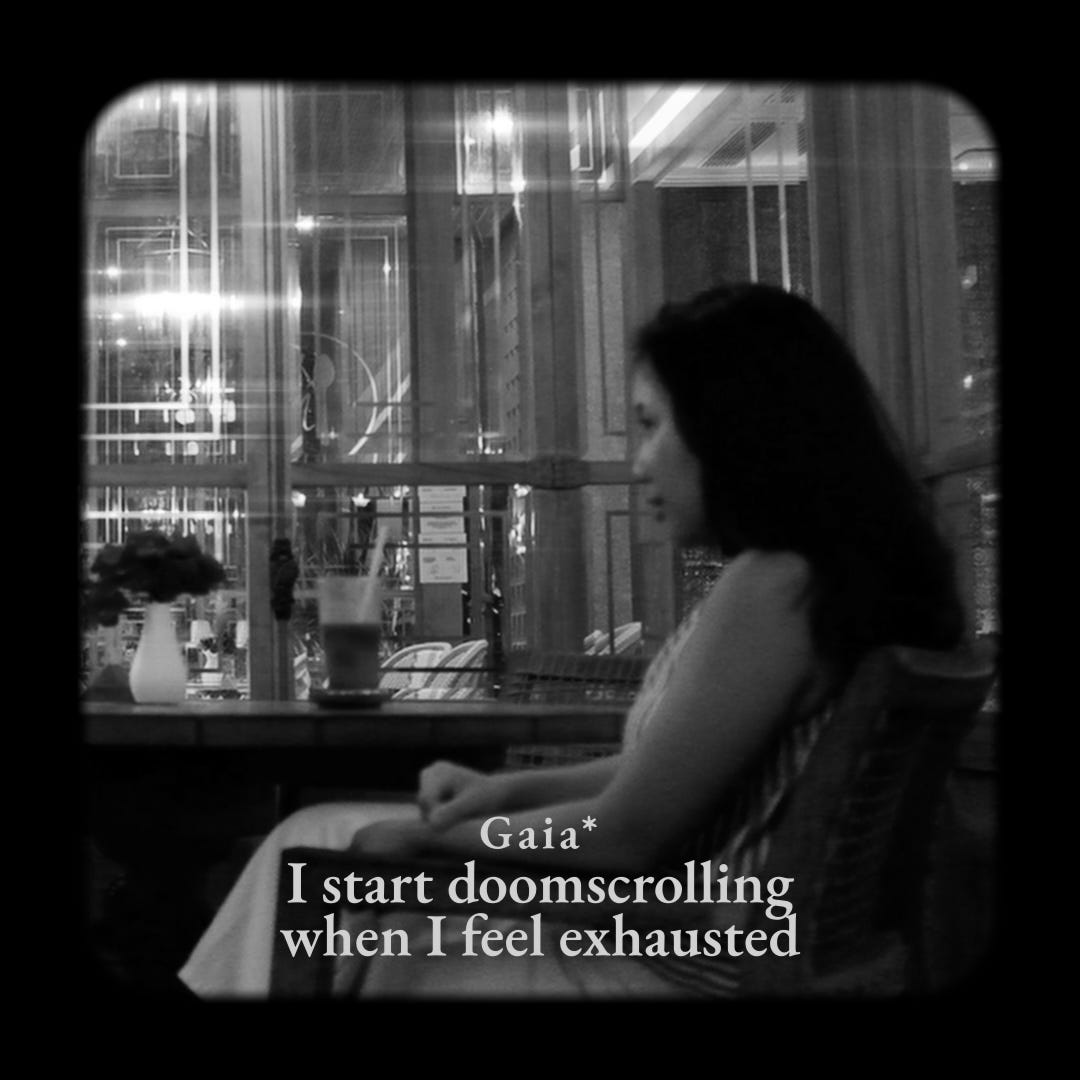
“I noticed I would start doomscrolling when I feel exhausted. When I feel overwhelmed. When I feel lonely. When I’m afraid of my own thoughts. When I think that I cannot be left alone with my thoughts.”
Gaia wouldn’t have recognised these tendencies if not for the exercise. But one session of inquiry alone is barely enough to cover the many ways doomscrolling reflects on her life and choices.
She told me she often caught herself doomscrolling even when she didn’t intend to. As if it’s a reflex in her body. In the morning, for example, when she reaches for her phone to turn off her alarm, she would find herself scrolling right after.
“Do you know what you’re looking for?” I asked her.
“I don’t know.”
Doomscrolling has become a habit for her. And when something is a habit, one stops thinking critically about it. One simply requires its presence in one’s daily routine because if it’s not there, something feels missing.
What I’m noticing from my conversations so far is that the point of doomscrolling changes with context. There is the doomscrolling we do as a habit, which contributes to giving a sense of rhythm to our day. There is also the doomscrolling we do as a coping mechanism, which provides us with a sense of comfort when we’re facing life’s difficulties.
I would make the case that acknowledging these two modes and identifying when it’s the former or the latter would help us in understanding why we doomscroll.
I’ll explore this distinction in my upcoming editions, starting with what doomscrolling as a coping mechanism looks like.
Stay tuned.
*Note: The name is pseudonymised.